

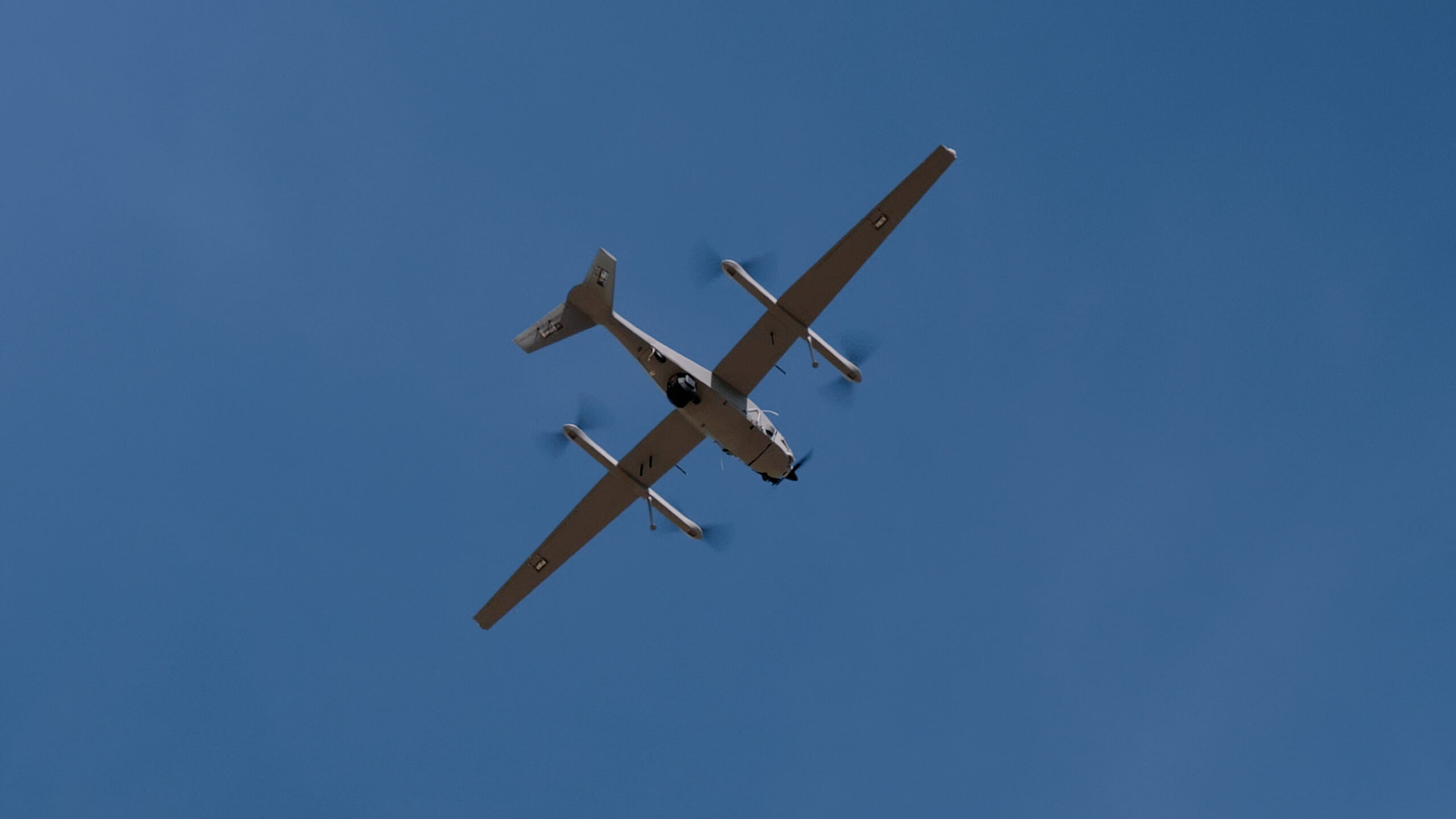
- Integrated Warden and AR3 EVO systems detected and tracked points of interest during a shipborne amphibious operation at REPMUS 2026.
Lisbon, Portugal, 24 November 2026 — Arkeus, a defence technology company delivering hyperspectral autonomous perception systems, and TEKEVER, Europe’s leading provider of AI-powered autonomous systems, successfully detected, identified and tracked points of interest during amphibious operations at REPMUS 2026, demonstrating an integrated intelligence, surveillance and reconnaissance (ISR) capability that evolves seamlessly from maritime to littoral and to land environments.
The demonstration combined Arkeus’ Warden autonomous perception system with TEKEVER’s AR3 EVO uncrewed aerial system aboard a Portuguese Navy vessel. Following land-based training flights, the integrated systems supported an amphibious operation, detecting, identifying and tracking points of interest, including Marines landing ashore.
Data collected during the mission was successfully imported into ATLAS, TEKEVER’s mission management platform, where it was converted into actionable information and made available to the wider REPMUS operational environment to support faster, better-informed decision-making. The demonstration highlighted how autonomous perception at the edge can contribute to a shared operational picture across maritime, littoral and land environments, extending ISR capabilities from shipborne platforms to support maritime and amphibious operations.
“Operators need to be able to find what matters across vast areas quickly enough to act,” said Simon Olsen, CEO of Arkeus. “As autonomous platforms become more central to defense operations, they need the perception to understand their environment, not simply collect more imagery. This demonstration showed how Warden can provide that perception across maritime, littoral and land environments and deliver decision-ready intelligence at the edge.”
Pedro Petiz, Director of TEKEVER for Portugal, said: “Naval operations require forces to keep visibility from the seabed to the shore. Our collaboration with Arkeus on REPMUS reinforces the role of the AR3 EVO for these missions by enhancing situational awareness for naval forces and supporting better decision-making as mission requirements evolve.”
AR3 EVO’s long endurance and adaptability enable extended surveillance missions in maritime and terrestrial environments under evolving operational requirements, with the flexibility to integrate a wide range of advanced ISR payloads. Forged on the battlefield, the EVO features precision vertical take-off and landing (VTOL) capabilities, allowing the system to operate from confined spaces of just 5×5 metres, including flight decks on moving vessels.
Warden combines advanced hyperspectral optical sensing with onboard AI to autonomously detect, recognise and track mission-relevant objects across wide areas. Designed for tactical unmanned platforms, it supports operations across maritime, littoral and land environments, including at night and in degraded visual conditions. By processing information at the edge, Warden reduces the need for operators to sift through large volumes of raw sensor data.
The demonstration builds on previous integration and flight testing of Warden aboard AR3 EVO, advancing the combined capability into a multi-domain operational scenario. AR3 EVO’s modular architecture enables the platform to adapt to different missions and payload configurations, while Warden brings autonomous wide-area perception to the platform.
Together, Warden and AR3 EVO demonstrated a deployable ISR capability that can move with the force, operate across maritime and land domains, and connect edge-generated intelligence into a wider operational environment.