

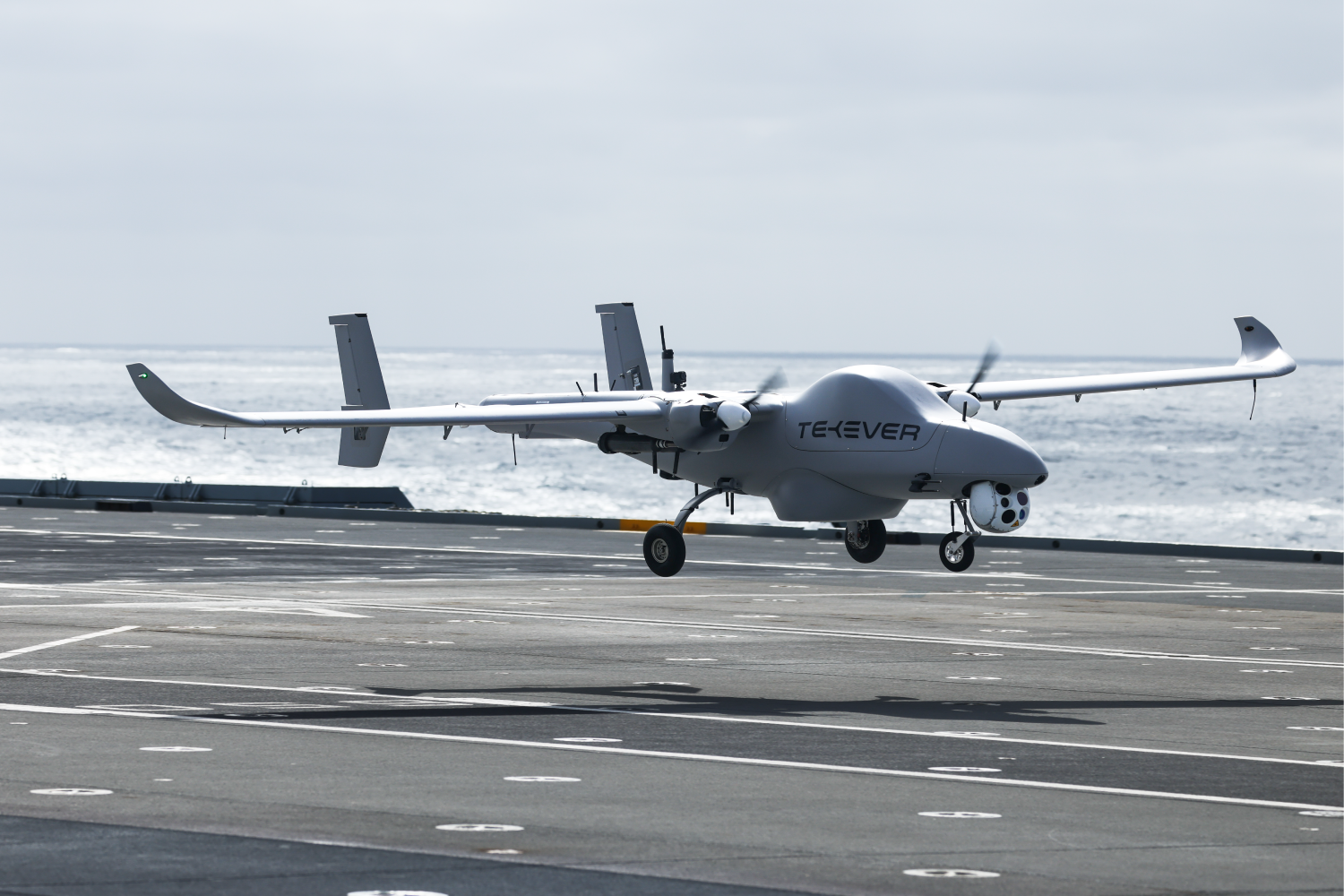
- Demonstration validates the AR5’s ability to operate from a carrier, enabling greater operational flexibility, extended maritime reach and a wider range of shipborne missions.
- The Heavy Lift Challenge 3 demonstration explored how the fixed-wing uncrewed aircraft could support logistics, sustainment and maritime ISTAR missions.
Bristol, United Kingdom, 4 November 2026 — TEKEVER’s AR5 operated from the flight deck of HMS Queen Elizabeth during Heavy Lift Challenge 3, marking the first time an AR5 had operated from a Royal Navy aircraft carrier.
After taking off from TEKEVER’s Flight Operations and Training Centre in Atouguia da Baleia, in Portugal, the aircraft flew for around 90 minutes before reaching the carrier. It then completed two landings and two take-offs from the flight deck before returning to Atouguia da Baleia on an approximately 120-minute flight back to land.
The demonstration showed how an uncrewed fixed-wing aircraft could be launched and recovered at sea, giving naval forces additional options for logistics, sustainment and intelligence, surveillance, target acquisition and reconnaissance (ISTAR). It also explored how the AR5 could operate alongside other systems in a carrier group.
The wider trials were delivered through close collaboration between the Royal Navy, British Army, RAF and industry partners.
Tiago Nunes, TEKEVER Director of Platforms, said: “Operating an AR5 from a carrier for the first time marks an important step in bringing more proven capabilities into naval operations. TEKEVER is enabling naval forces to conduct missions with greater flexibility, extend operational reach, and respond to evolving requirements at sea. This demonstration showcases the level of systems integration achieved by working closely with the Royal Navy, turning advanced autonomous technology into capabilities delivering real operational value.”
Lieutenant Commander David Burton, trials sponsor for Navy Capability at the Royal Navy, added: “Heavy Lift Challenge 3 and Rapid Eagle have demonstrated the significant potential that autonomous fixed-wing systems could offer to future maritime operations. The successful operation of a TEKEVER AR5 from HMS Queen Elizabeth has provided valuable insight into how uncrewed systems might support logistics, sustainment and wider operational tasking in demanding maritime environments. Working alongside colleagues from Project Corvus and Pantheon has also highlighted the benefits of connecting future ISTAR, logistics and operational capabilities into a more coherent system. Activities such as Rapid Eagle help us understand how autonomous technologies can increase operational flexibility, extend reach and support the Royal Navy’s transition towards a hybrid navy.”
With enhanced capability and extended endurance, the AR5 is equipped for a range of land and maritime missions at reduced operating cost — including search and rescue, border surveillance, and maritime patrol. Operationally proven in the harshest conditions, the system features a flexible architecture and fully autonomous take-off and landing, even on short or unpaved platforms.
TEKEVER continues to strengthen its industrial presence in the UK through OVERMATCH, its five-year, £400 million investment programme focused on research, infrastructure and defence technology, including AI and autonomy.
Recently, the UK Ministry of Defence awarded TEKEVER the Project CORVUS contract to deliver its AR5 long-endurance uncrewed aerial system to the British Army. The programme will provide a persistent intelligence, surveillance and reconnaissance capability.